Men – Pray For Your Wives (Part 1)

Today I want to speak directly to men. Guys, let’s talk about prayer. No, this isn’t a beat-down or a shame-fest meant to cajole you into spending more time in prayer.  The congregation I have the blessing to pastor, knows that this is not a tactic I employ.  Shaming people into doing something never works in the long run.

Instead men, I want you to consider why you should pray for your wives AND more importantly, what your frame of reference should be.  A recent article on this subject got me thinking about this topic and provided a great example of the right approach to praying for our wives.

What is that right approach?  Simply this – men we are to pray for our wives so that we can be changed.  I can almost hear all the “what?” questions right now.  “What do you mean pray for my wife so that I can change?”  “She is the one that needs to be changed!”

Here is a spiritual principle to try on guys – you only have control over your responses. You cannot control the responses of other people. In fact, you will never see the changes you want in your wife until you become the change you want to see.  The old adage that warns not to point fingers at others for their faults because there are at least three fingers pointing back at you comes to mind here.

So, how does praying for your wife with the proper attitude change you? Because praying for your wife with the right attitude will soften your heart.  I know this is true from personal experience.  You cannot honestly pray for someone you are mad at or aggravated with. I have counseled many men over the years to put this principle to the test. My counsel to them has been this – the next time you and your wife find yourselves in a discussion that is heading “out of bounds,” have the courage to stop, look your wife in the eyes, take her hands, and say “let’s pray.”

When you pour your heart out for your wife, when you seek God and ask Him to encourage her to be all that she can be in Him, I guarantee you God will show you ways that you are hindering her in that quest. Men, we are sinners and more often than we want to admit, we display a callousness toward them that really undermines the very character qualities we desire to see in her.

I will focus on this subject in four additional posts. We will continue this conversation about the great need we have as men to pray for our wives. Look for Part 2 in this series soon.

May God richly bless you today as you seek Him.
The Ethics of Naturalism Are Unnatural

Two scenes from a movie I recently watched got me thinking about the ethics of naturalism.  Hollywood veteran Sylvester Stallone starred in the movie “Cliffhanger” and the suspense in the plot enabled it to live up to its name.

For those unfamiliar with this movie Stallone plays a trained mountain rescuer who along with fellow rescuer, actor Michael Rooker, are tricked into aiding a fugitive gang who have managed to steal several hundred million dollars from the Federal Reserve but during their escape by airplane are forced to crash-land in a desolate mountain range.

Playing a convincing role as the cold-hearted villain was actor John Lithgow.  The two scenes that caught my attention happened within minutes of one another.  The first scene showed one of Lithgow’s gang murdering a rescue helicopter pilot played by Ralph Waite.  In shock and dismay over this cold-blooded act, Rooker screams, “he never hurt anyone.” In other words, Waite did not deserve to die. Lithgow without missing s beat, in an equally cold-blooded line only remarked, “how touching.”

The second scene moments later featured Lithgow murdering his female companion to gain leverage in a struggle with his co-conspirators to maintain control of the quickly evaporating escape plan.  Just before Lithgow murders his female companion he asks her if she knows what the greatest virtue of love is.  Before she can answer Lithgow answers for her by whispering in her ear, “sacrifice.” He then promptly murders her.

This is a violent movie but is candid in its portrayal of man’s dilemma ethically speaking.  These two scenes clearly demonstrate the great paradox that man faces when trying to explain and live an ethical life apart from belief in God as the moral law giver.  In the first scene Lithgow exhibits a naturalistic worldview, one completely in-line with a Darwinian evolutionary view. Being heartbroken over the death of a friend is nonsense to Lithgow and thus his “how touching” remark.  Clearly implied is the rest of the statement that could be stated: “how touching and how utterly stupid.”

Contrasting that naturalistic ethic Lithgow espouses a different ethic in the second scene in justifying his murderous behavior.  Where did he find any ground for love as sacrifice?  These two scenes present ethics opposed to one another.  Perhaps the writers of this movie script meant to mock the Christian ethic of God as moral law giver.  I think a better explanation is that they intentionally portrayed where mankind is left if God is indeed dead.

The truth is that naturalism cannot provide an ethical foundation for love, sacrifice, compassion or anything human beings are said to need to survive as communities and nations. Naturalistic ethics that speak of these qualities have smuggled Christian theistic ethics into their system without due recognition because of course that would betray their underlying beliefs.  They cannot admit to what they claim does not exist.  This makes naturalism’s ethics quite unnatural.

When God is declared dead there is only one place man can turn for the source of ethics – himself.  This opens the floodgates for all forms of abuse and evil.  The twentieth century alone provides testimony to the validity of this truth.

Friends, I encourage you to continue to stand firm in your faith and in your testimony.  What your family, friends, and neighbors need today are answers to the myriad contradictions they encounter every day, not the least of which is the convoluted ethics of naturalism.

This is A Transforming Moment waiting to happen.

Pastor You Are Just A Bus Driver

Know that the Lord Himself is God; It is He who has made us, and not we ourselves; We are His people and the sheep of His pasture. Psalm 100:3

One of the many challenges that church leaders face is the challenge to remember that our brothers and sisters in the faith belong to God.  They are His people and as our focus passage states, “sheep of His pasture.”

This highlights some very important implications.  For instance, men and women who make your church their spiritual home, do so as a result of their relationship with God.  He has entrusted them to your care for a season.  They need sound spiritual guidance from you.

Second, it is God who will sustain His people. How does God do that? God does that by feeding them in His pasture.  That may be your church for a season but it can just as easily be another church in another season. But even while being a part of your church, God’s people should be partaking of solid spiritual food as a result of their personal communion with Him. Yours should not be the only voice they hear.

Why do I bring this up?  For this simple truth – far too many church leaders today, behave as if God has assigned people to their churches for as long as they live.  Now before you church leaders start getting yourself all worked up, hear me out.  What I am suggesting to you is that you are merely a bus driver in the Kingdom of God and not a warden.  In other words the church door swings both ways. And it is my belief we should encourage that.

People will get on and off the bus at every stop you make on this faith journey called life. We should not be surprised by this.  The days of 3rd and 4th generation families calling the same church their home, are rare according to recent statistics.

Given that fact, shouldn’t church leaders be preparing people to be Kingdom builders in their own right?  What would happen if more church leaders actually discipled God’s people under their care, to go out and start new churches?  That would create a Gospel title wave that would sweep across our nation, something we desperately need in America today.

Church leaders – take seriously your role as a Kingdom bus driver and watch the amazing things that will happen as a result.  That will be a transforming moment in your life.

Three Keys To Effective Prayer

I call upon you; answer me, O God. Turn your ear to me; hear my speech. Psalm 17:6

When was the last time you contemplated the importance of prayer? Almost everyone has an opinion on times, places, and frequency concerning personal prayer.  But have you taken the time to understand just how important prayer is to your spiritual life?

Psalm 17 is a prayer of King David, written down for our benefit.  His opening petition is instructive: “Hear, Lord, my plea for justice; pay heed to my cry.”  I think we can all connect to this idea – that God will hear and answer our cries.  We expect God to hear us and to answer us.

Since that is the case, what should our attitude concerning prayer be? I see at least three principles in this Psalm that if employed consistently will yield much fruit in our lives. I encourage you to study Psalm 17 on your own, to not only see these three principles but to see what else God might show you.

Here are the three principles: (1) Stay alert – don’t let your mind drift. How many of you will admit that you start off your prayer time with good intentions but before you know it you’re thinking about items on your “must do” list. David’s prayer is focused.  Keep in mind the Apostle Paul’s admonition to the Colossian believers to “persevere in prayer, being watchful in it” (Col. 4:2).

(2) Be specific with your petitions. When you go to a restaurant you don’t ask the waiter to “bring me food.” You specially request what you would like – “sirloin steak, medium rare.” Prayers that are nothing more than generalizations or meaningless catch-phrases ask for nothing and will receive the same in return.

Finally, (3) Expect to receive. If you pray simply from habit expecting to receive nothing from God, then you are really wasting your time. James the brother of Jesus said that when we pray we should pray “in faith, not doubting.” The whole point of prayer is that we are making our petitions known to God who will answer us according to His goodness and kindness.

Friends, prayer can change our lives when we approach it with a right understanding of its place and power.

This is a transforming truth.

A Thanksgiving Reflection

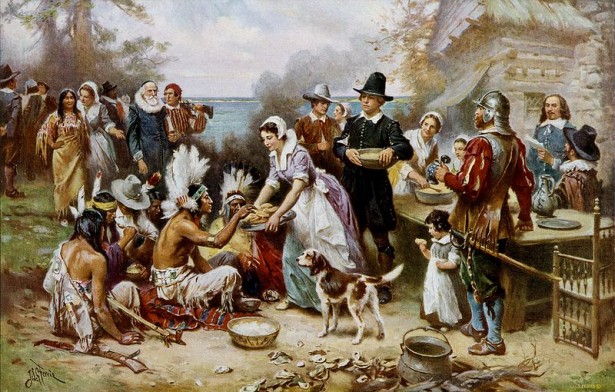
first-thanksgiving

Today is Thanksgiving Day in America.  A day that is for the most part a celebration of our history as a nation, (although very dimly remembered) and all that is good and right about America.  This is not to say that America is without blemish for we surely have fallen in many instances, and continue to fail to uphold the ideals which our forefathers envisioned.  Nevertheless today is a day of giving thanks for the lives we have and the many attendant blessings, whether we use that particular word or not.

In the midst of this time of reflection I wonder though about the many Americans who increasingly disavow God.  If current studies are accurate and the latest statistics can be believed, Americans are becoming more secular and less religious in significant numbers.  This has a direct bearing on our ability to see life as precious and worthy of our best efforts.

Continue reading